This is a personal experience note and educational ingredient guide, not medical advice. If this page later includes affiliate links, that will be stated here. Skin responses vary.
The context
My skin & context
- Skin
- Slightly Dry / Slightly Sensitive
- Routine examples
- Torriden serum and AESTURA cream
- What this is not
- An ingredient isolation test
The short answer
The short answer
Hyaluronic acid helps bind water, and ceramides support the skin’s lipid barrier. For dry skin, look at the whole moisturizer, not only the ingredient named on the front.
Hyaluronic acid gets attention for hydration. Ceramides get attention for the skin barrier. When your skin feels dry, both sound like the right answer.
They can be. But they do different things, and a product’s headline ingredient is only part of the reason it works.
The useful distinction is water binding versus barrier lipids. Hyaluronic acid is a humectant that helps bind water. Ceramides are lipids involved in the outer skin barrier, where they help limit water loss. A moisturizer can bring those roles together. [1, 2]
The difference at a glance
| Question | Ceramides | Hyaluronic acid |
|---|---|---|
| What are they? | A family of lipids naturally present in the skin | A water-binding molecule also found naturally in the body |
| Main skincare role | Supporting the skin’s lipid barrier in a suitable formula | Helping increase hydration through water binding |
| What else matters? | How the lipids are formulated and delivered | The complete formula, including ingredients that help reduce water loss |
| Does the name tell you the texture? | No. Ceramides are used in different product formats | No. HA can appear in serums and richer moisturizers |
| Do you need a separate product? | Not necessarily | Not necessarily |
These are ingredient roles, not a ranking of finished products. [1, 2, 3]
What ceramides do
The outermost layer of skin contains cells surrounded by a lipid mixture. Ceramides are an important part of that mixture, alongside cholesterol and free fatty acids. Its organization matters for the barrier that regulates water loss. [2]
That explains why ceramides appear in so many barrier-focused moisturizers. It does not mean every cream with a ceramide on its ingredient list performs equally well.
A 2024 review emphasizes that the way ceramides are incorporated into the final formula matters. The presence of the ingredient is not the same thing as evidence for the finished product. [2]
For shopping, that means “contains ceramides” is useful information, but it is not enough to choose a moisturizer on its own. Counting the ceramides on the box also does not tell you which cream will suit your skin better.
What hyaluronic acid does
Hyaluronic acid’s useful role here is water binding. In topical skincare, it is used as a humectant to support hydration. That role is different from supplying the lipids involved in the skin barrier. [1, 3]
An HA serum can be one hydration step. An HA-containing cream may already provide hydration alongside other moisturizing ingredients. The word “hyaluronic” does not make a product inherently lightweight or tell you whether it replaces a moisturizer.
Research on topical HA includes different formulations and molecular weights. A result from one formulation is not a guarantee for every HA serum, and it does not establish a rule that more types of HA on the label always mean better results. [3]
Why the whole moisturizer matters
Moisturizers commonly combine several functions:
- Humectants, such as glycerin and hyaluronic acid, help bind water.
- Emollients help soften and smooth the skin.
- Occlusive ingredients help reduce water loss from the surface. [1]
Those functions are often combined in one product. Ceramides add a barrier-lipid dimension, but they do not make the rest of the formulation irrelevant. [1, 2]
This is why “ceramides or hyaluronic acid?” can be a less useful shopping question than “does this moisturizer give me enough hydration and lasting comfort?”
The American Academy of Dermatology generally recommends creams or ointments rather than lighter lotions for dry skin. It also identifies both ceramides and HA as ingredients worth looking for. Texture and the overall formula deserve attention alongside the featured ingredient. [4]
If your serum feels good but your skin still feels dry
Before adding another hydrating layer, check whether you are relying on a serum alone. A humectant-focused serum is not automatically a complete substitute for a moisturizer.
For a simple routine, start with a moisturizer you tolerate. If it provides enough hydration and comfort, a separate HA serum is optional. If you already enjoy using a hydrating serum, you can follow it with your moisturizer instead of treating the two steps as competitors.
Applying moisturizer after washing, while skin is still slightly damp, is consistent with AAD guidance. It does not require a dedicated face mist or multiple toners. [5]
How this fits into my own routine
My skin is slightly dry and slightly sensitive. I use Torriden DIVE-IN Hyaluronic Acid Serum after toner in my evening routine. I find it hydrating without a sticky finish.
AESTURA ATOBARRIER365 Cream is also a product I use. These are examples from my routine, not a test that isolates hyaluronic acid or ceramides. How a product feels on my skin cannot tell me which ingredient caused that feeling.

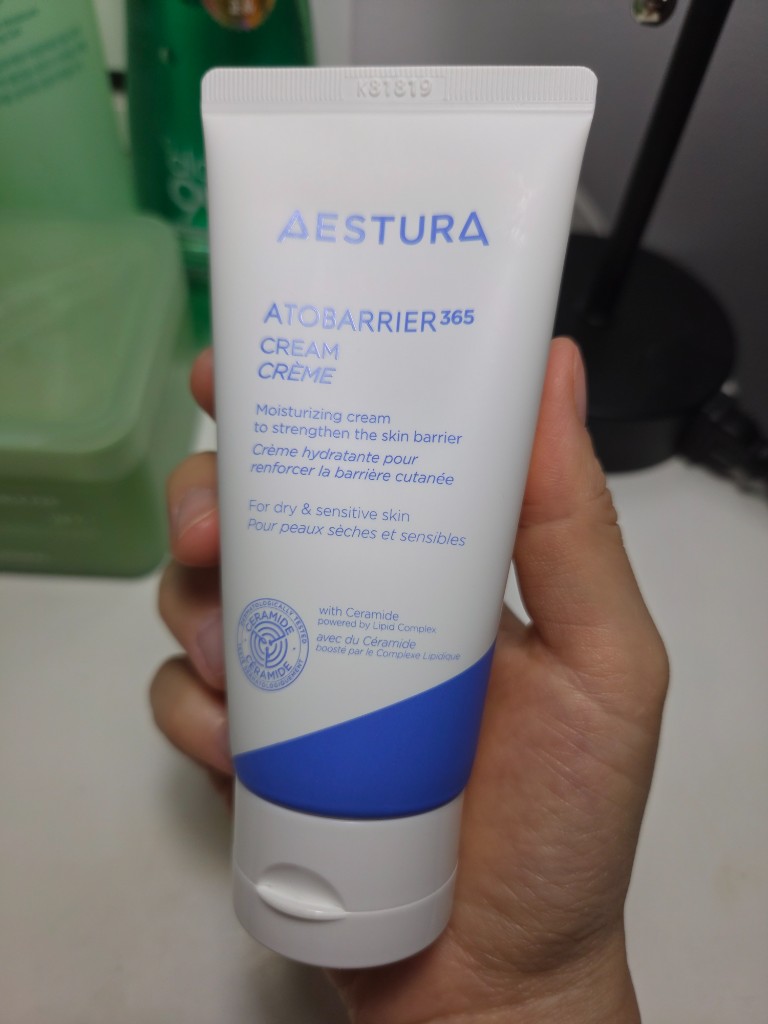
For the actual product experiences, read my Torriden DIVE-IN Serum review and AESTURA ATOBARRIER365 Cream review.
I also have a Torriden cream vs AESTURA comparison. That article compares two finished moisturizers. It should not be read as a head-to-head experiment on these two ingredients.
What I would look for on the label
Start with the product format and the full ingredient list, then consider the featured ingredient. For dry skin, a cream may be a more useful starting point than another watery serum. If your skin is sensitive, AAD guidance favors fragrance-free products. [4, 5]
You do not need a ceramide cream plus a separate HA product simply to have both roles in your routine. One moisturizer can include both. Neither ingredient makes the complete formula automatically suitable for everyone.
If a product causes burning, stinging, or irritation, do not interpret that as proof it is repairing your barrier. Persistent dryness or irritation deserves a dermatologist’s assessment rather than an endless search for another serum. [5]
For dry skin, I would put a comfortable, dependable moisturizer first. Ceramides and hyaluronic acid can both be useful parts of it; the label is the beginning of the decision, not the whole decision.
Sources
- Moisturizers, StatPearls / NCBI Bookshelf. Overview of humectants, emollients, and occlusives.
- The role of ceramides in skin barrier function and the importance of their correct formulation for skincare applications. Review, 2024.
- Benefits of topical hyaluronic acid for skin quality and signs of skin aging: From literature review to clinical evidence. Review and clinical evidence, 2022.
- How to pick the right moisturizer for your skin, American Academy of Dermatology.
- Dermatologists’ top tips for relieving dry skin, American Academy of Dermatology.
Sources checked September 30, 2026. This article explains skincare ingredients; it does not diagnose a skin condition.